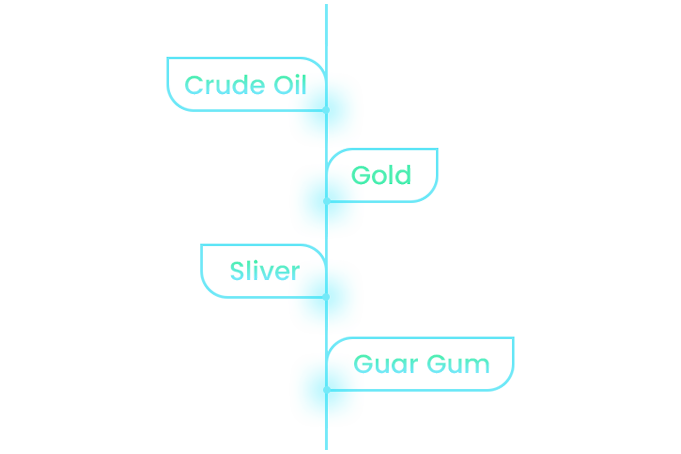
Commodities represent raw materials critical to the global economy. Integrating them into your financial strategy offers unique mechanisms for wealth preservation and growth that traditional equities and bonds cannot provide.

As prices for goods and services rise, the value of the raw materials needed to produce them typically rises as well, protecting your purchasing power.

Commodities historically have a low to negative correlation with traditional asset classes like stocks, reducing overall portfolio volatility.

Prices are driven by fundamental global supply and demand metrics, offering opportunities based on macroeconomic trends and geopolitical events.
Safe haven assets highly responsive to global inflation rates, currency fluctuations (USD), and geopolitical tensions.
Highly volatile sector driven by OPEC+ decisions, global inventory data, and macroeconomic growth projections.
Industrial building blocks. Prices correlate strongly with manufacturing PMIs, infrastructure spending, and supply chain logistics.
Driven by seasonality, monsoon forecasts, crop sowing data, and government export/import policies.
Depending on your financial goals, risk appetite, and market outlook, commodities can be utilized in several strategic ways. Select an approach below to understand how participants interact with this market.
Primarily used by producers and consumers of physical commodities to lock in prices and protect against adverse market movements.
Traders attempt to profit from the directional price movements of commodities without the intention of ever taking physical delivery of the asset.
The simultaneous purchase and sale of an asset to profit from an imbalance in the price. It is a trade that profits by exploiting the price differences of identical or similar financial instruments on different markets.
Commodity trading involves substantial risk and is not suitable for every investor. Understanding these core mechanics is crucial before committing capital.

Commodities are traded on margin. While this magnifies potential profits, it equally magnifies potential losses. It is possible to lose more than your initial investment if the market moves sharply against your position.

Commodity prices can be highly volatile. They are sensitive to unpredictable factors such as weather patterns, geopolitical instability, and sudden shifts in global supply chains. Stop-loss strategies are essential.

Unlike stocks, derivative contracts have an expiration date. Traders must be aware of tender periods. SBJ Multicom systems generally prompt users to roll over or close positions before physical delivery becomes mandatory.
Access MCX and NCDEX markets seamlessly through our flagship platforms. Whether you are a high-frequency derivative trader or a portfolio diversifier, we have the right tool for you.
The advanced web terminal for professional commodity traders. Built for speed, deep technical analysis, and complex options strategies.

Lightning-fast mobile trading. Keep the commodity markets in your pocket with intuitive design, instant alerts, and one-tap execution.
Read our latest articles & insights on commodities.
You can apply for an IPO through our platform using UPI as the payment mechanism. Enter your UPI ID, select the lot size, and approve the mandate on your UPI app.
You can open an account completely online via our platform. You will need your PANcard, Aadhaar card (linked to mobile for eSign), a cancelled cheque, and an income proof (if you wish to trade in derivatives). The process usually takes less than 15 minutes.
SLBM allows long-term investors to lend their idle shares for a fee, and enables short-sellers to borrow shares to meet their delivery obligations. As a SEBI registered broker, SBJ facilitates these transactions on the exchange platform.
As per current exchange rules, all open ITM stock options at expiry are subject to compulsory physical delivery. You must either have the necessary funds or the required shares. To avoid physical delivery, it is recommended to square off positions before expiry.
SBJ Multicom offers Direct Mutual Funds, meaning zero commission is paid to us as distributors. Standard exchange transaction charges and DP charges may apply as per our tariff sheet.